New chapter: Making group work ‘work’
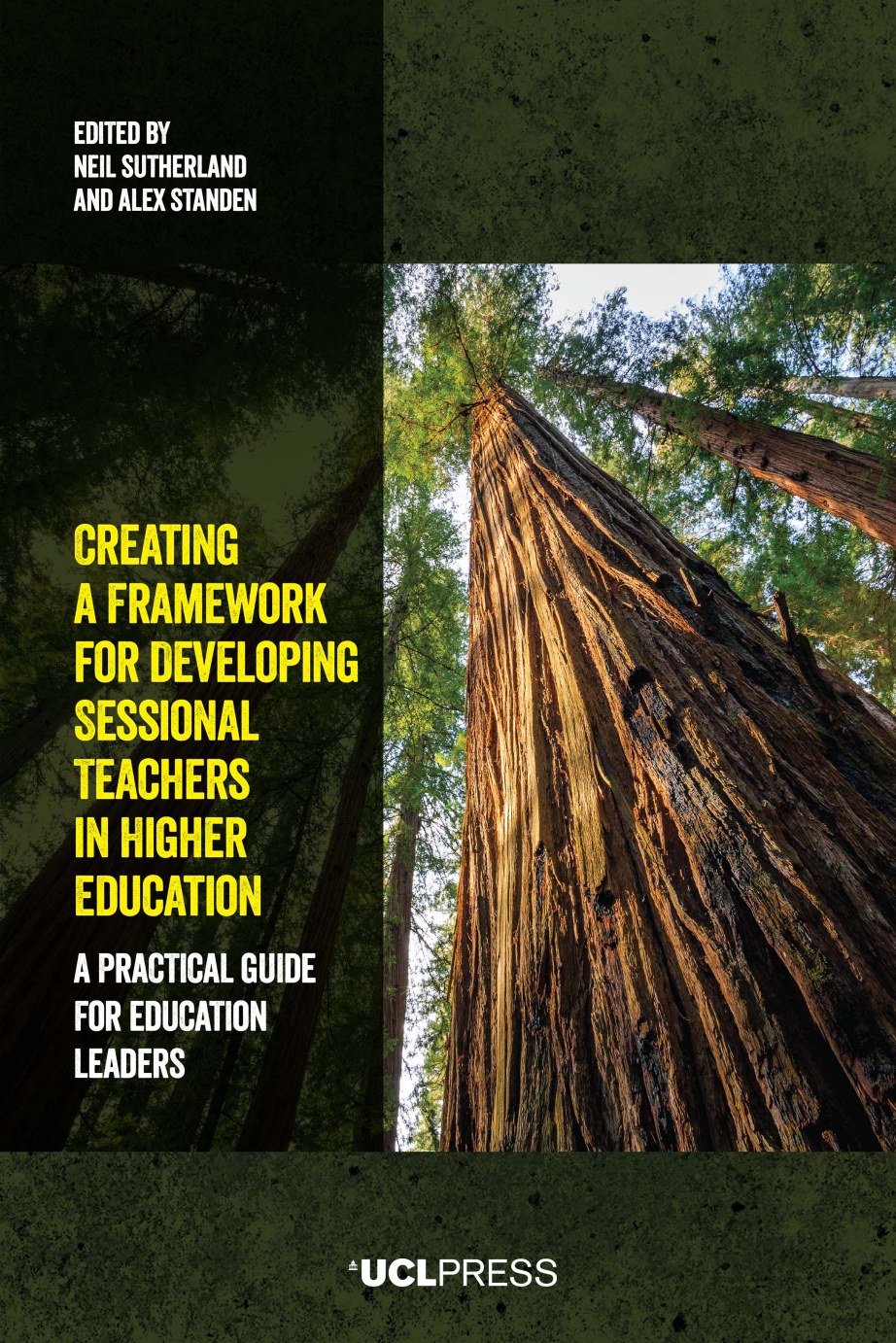
I’m delighted to share that Jillian Terry and I have a chapter in a new book from UCL Press, Creating a Framework for Developing Sessional Teachers in Higher Education: A practical guide for education leaders, edited by Neil Sutherland and Alex Standen. It has been a long road to getting the book out, so I’m very pleased that it’s finally here. It’s open access, so you can read or download the whole book for free.
Our chapter, ‘Making group work “work”: how can sessional teachers facilitate effective interdisciplinary student collaboration?’, draws on our experience at LSE100. Jillian is the other Co-Director of LSE100. We have each spent around a decade on the course, and more than five years leading it together. A lot of that time has gone into supporting our team through one of the most demanding parts of the course: the group research projects.
Group work at scale
Every year, LSE100 students work in small, deliberately interdisciplinary teams on a research project lasting around four months. Each group meets fortnightly with their teacher, who supervises them as they develop a proposal for positive change in a social system. The projects end with a presentation to their peers and a report written for a specific audience.
The numbers are large. This academic year we’ll have 2,200 students working in 440 groups across 88 classes, supported by a team of 13 teachers: our most projects ever. (When we wrote the chapter, the course had around 1,800 students and a team of eight Fellows, so if anything the questions it addresses have become more pressing.) At this scale we see every possible variation of challenging group dynamics, exciting research topics and logistical problems, so consistency and support for teachers are essential.
Key takeaways
Interdisciplinary groups have unique challenges
The familiar problems of group work still turn up: free-riding, uneven participation, mismatched expectations and the occasional domineering member. Mixing disciplines brings further challenges. Groups can split into disciplinary camps, or end up as a set of solo experts each writing their own section, which gives you a multidisciplinary project with no real integration. Students can talk past each other because the same word (such as ‘development’ or ‘methodology’) means different things in different fields. Some dismiss contributions from peers they see as unqualified in their discipline, while others hold back because they feel they lack the credentials to contribute. Because many students’ sense of identity is bound up with their discipline, a disagreement about which disciplines matter can quickly become personal. The quieter version, where one student is gradually sidelined, is often harder for a busy teacher to spot than an open argument.
Train for the interdisciplinary scenarios, not just generic group work
General training in supporting group work is valuable, and with LSE’s Eden Centre for Educational Enhancement we take teachers through specific scenarios, such as a student whom others say isn’t contributing, or one who dominates discussion. But teachers also need to be ready for the interdisciplinary problems above, including treating clashes of terminology as learning opportunities rather than simply obstacles. It also matters that teachers reflect on their own disciplinary assumptions, since a supervisor can unintentionally steer a group towards the approach of their own field. More recently, our teachers have also completed certified training in dialogue-building for contested topics, whose methods are designed to build bridges between people with different knowledge, perspectives and approaches.
Build the tools centrally
Sessional teachers rarely have time to design their own systems for managing dozens of projects, so we provide them. A shared group tracker spreadsheet is used first to form the groups, balancing students’ topic preferences with disciplinary diversity, and then to record concerns, the action taken and how each issue was resolved. Because it sits in our shared Teams space, a colleague covering a class has the full picture of every group. As part of our work as LSE AI and Education Fellows, Jillian and I have been exploring AI-enabled ways to help teachers form their groups and track their progress using these central tools, so look out for more on that soon.
Let students hold each other accountable
In their first meeting, each group completes a team charter setting out their expectations of each other, how they will communicate and the roles they want to take on. Groups use it to manage themselves, which reduces the need for teachers to step in. When problems do arise, the teacher can ask the group to look back at what they agreed and where things have drifted. Students have told us that they value having this kind of accountability mechanism.
Teach collaboration alongside the course
Working with the LSE Learning Lab, we offer workshops and skills exercises on collaborating, giving a group presentation and writing a group report. These support students without adding to teachers’ workloads, and give teachers somewhere to point a group that is struggling.
Make troubleshooting a team effort
Our team meets weekly during term, and while the projects are running a good part of each meeting is given over to sharing problems and successes. A dedicated Teams channel lets this continue between meetings. For this to work, the atmosphere has to be free of blame and competition: if teachers feel they are being judged on whether their groups run smoothly, they stop sharing exactly the difficulties the rest of the team could help with. Because our teaching team is itself drawn from many disciplines, these conversations also model the kind of interdisciplinary collaboration we ask of students.
Treat development as part of the job
Underpinning all of this is the view that training should be built into teachers’ workloads rather than treated as an extra. Our Fellows regularly tell us that they draw on this experience in job interviews and in their later roles, so the benefits reach well beyond the course itself. In the end, what makes a teaching team work is much the same as what makes a student group work: open communication, collegiality and good shared information.
Thank you
Thank you to Jillian for working so hard on this alongside me, and for the many years we have spent working through these problems together. Thanks too to the other contributors, whose chapters cover an impressive range, from induction and teaching observation to mentoring, intercultural communication, marking, feedback and building communities of practice. Above all, thank you to Neil and Alex, whose tireless work as editors brought the project to fruition.
The whole book is free to read and download from UCL Press. If you work with sessional teachers, or are one, I’d recommend it.
Reference
Terry, J. and Blunt, C. (2026). Making group work ‘work’: how can sessional teachers facilitate effective interdisciplinary student collaboration? In N. Sutherland and A. Standen (eds), Creating a Framework for Developing Sessional Teachers in Higher Education: A practical guide for education leaders, pp. 201–217. London: UCL Press. Book DOI: https://doi.org/10.14324/111.9781806551286. Chapter on JSTOR: http://www.jstor.org/stable/jj.38720061.22